
Enterprise AI · Leadership · Organisational change
Why AI Success Has More to Do With Culture Than Technology
Most organisations are not short of AI tools. They are short of the cultural conditions needed to use them well.
Executive summary
Most organisations have bought or licensed AI tools. Relatively few have changed the business processes, incentives, reporting lines and decision rights that determine whether those tools deliver real transformation. The result is a stubborn gap between AI expenditure and business impact.
Technology changes what is possible. Culture decides what is permitted, repeated and rewarded. Adoption is becoming commonplace. Transformation is not. Organisations that treat AI as a culture-first challenge — redesigning work, building trust, involving middle managers and measuring business outcomes rather than logins — are the ones that will convert AI capability into genuine competitive advantage.
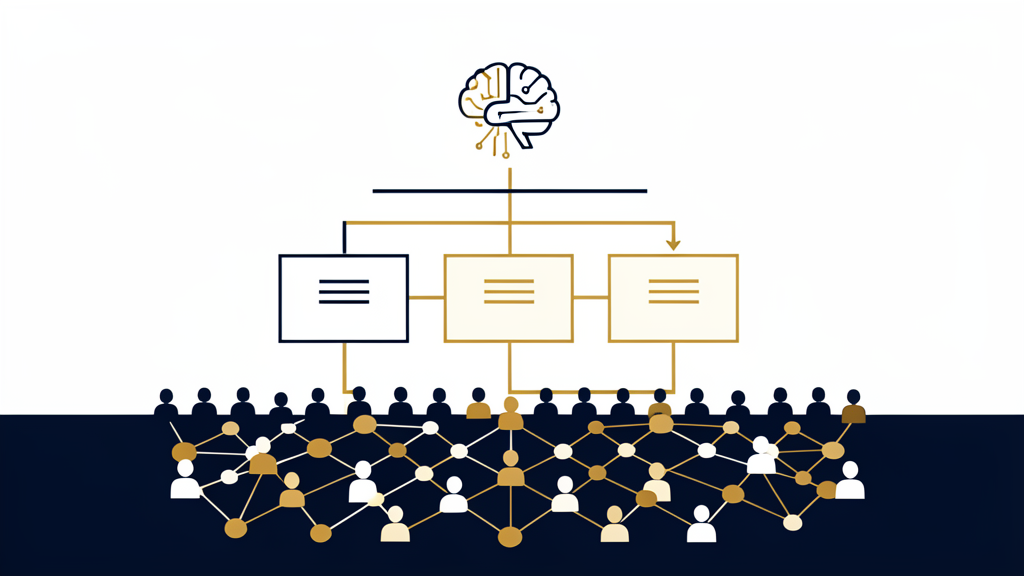
Most organisations are not short of AI tools. They are short of the cultural conditions needed to use them well.
That is the uncomfortable truth sitting underneath much of the corporate AI boom. Over the past two years, businesses have rushed to deploy ChatGPT, Copilot, Gemini, Claude and a rapidly expanding zoo of AI-powered enterprise applications. Boardrooms have been briefed. Pilots have been launched. Innovation teams have been energised. Everyone has seen the demos. Yet in many organisations, the gap between AI enthusiasm and actual business transformation remains stubbornly wide.
The technology is not the weak point. The technology is astonishing. The problem is that tools do not transform organisations by themselves. They enter existing cultures, existing incentives, existing reporting lines, existing fears, existing habits and existing politics. Those things decide whether AI becomes a source of advantage or just another expensive experiment with a dashboard.
By culture, I do not mean beanbags, values posters or a cheerful sentence in the annual report. I mean the shared behaviours, incentives, norms, trust levels and decision rights that determine how work actually gets done when nobody is watching. Technology changes what is possible. Culture decides what is permitted, repeated and rewarded.
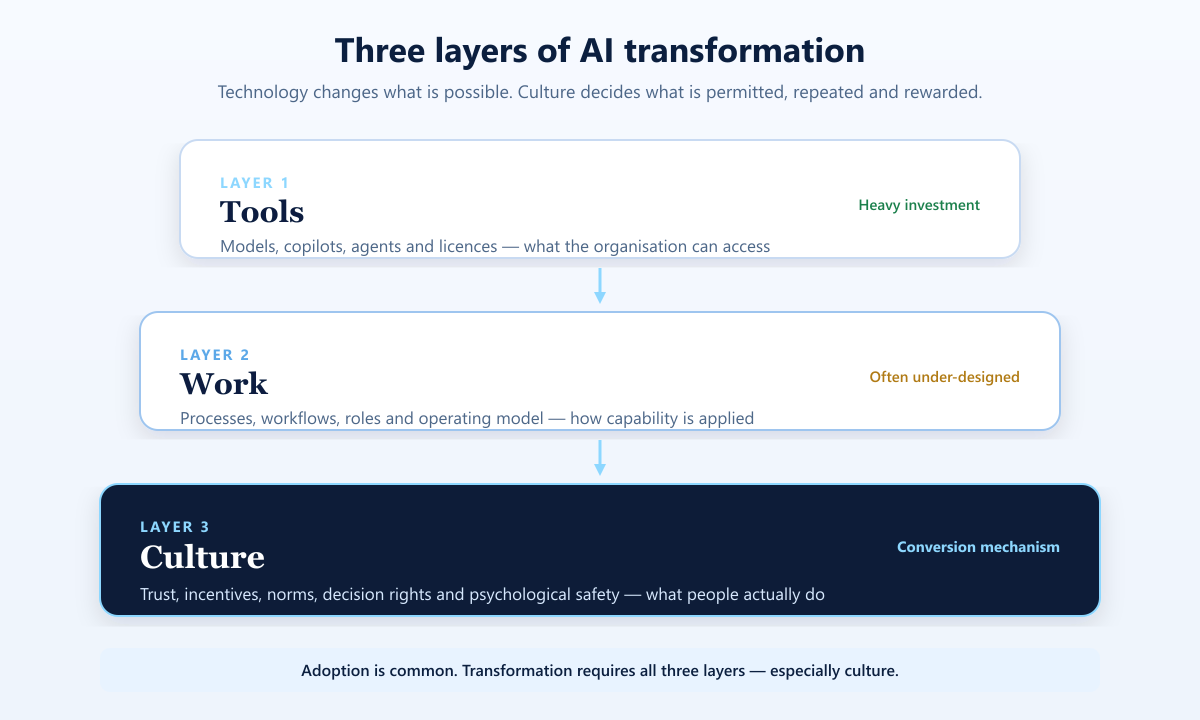
The three layers of AI transformation
A useful way to think about AI transformation is through three layers: tools, work and culture.
Tools are the AI capabilities made available to employees. Work is the process and operating model through which those capabilities are applied. Culture is the human system that decides whether people experiment, share knowledge, trust outputs, challenge mistakes, redesign processes and change behaviour.
Most organisations invest heavily in the first layer. The serious ones work on all three.
The evidence is hard to ignore
McKinsey's 2025 State of AI research found that 88% of organisations now use AI in at least one business function, up from 78% a year earlier. Yet the same research makes clear that most organisations have not scaled AI across the enterprise, and many have yet to see meaningful financial impact. A separate McKinsey survey found that workflow redesign was the factor with the strongest effect on whether organisations saw EBIT impact from generative AI, while only 21% of respondents said their organisations had fundamentally redesigned at least some workflows.
In plain English, many companies have bought the tools. Far fewer have changed the business.
BCG's AI at Work research tells a similar story: employees are increasingly using AI, but only 13% report AI agents being deeply integrated into their daily workflows. Deloitte's 2026 State of AI research points in the same direction from another angle: despite high expectations for automation, 84% of companies have not redesigned jobs or the nature of work itself around AI capabilities.
That is the real problem. Adoption is becoming commonplace. Transformation is not.
Agentic AI raises the cultural stakes
Many employees currently use AI as an assistant: something that drafts, summarises, analyses, codes or suggests. But the market is already moving toward agentic AI — systems that do not merely advise people, but act across workflows, applications and business processes.
An assistant helps an employee complete a task. An agent may complete the task itself.
That shift changes the question from "Can people use AI?" to "Can the organisation safely trust AI to act?" Trust, accountability, governance, decision rights, escalation routes and auditability become far more important when AI moves from recommendation to execution. If an AI system can trigger actions across customer, finance, HR, clinical, legal or operational workflows, then culture is no longer a soft factor. It is part of the control system.
The pilot trap
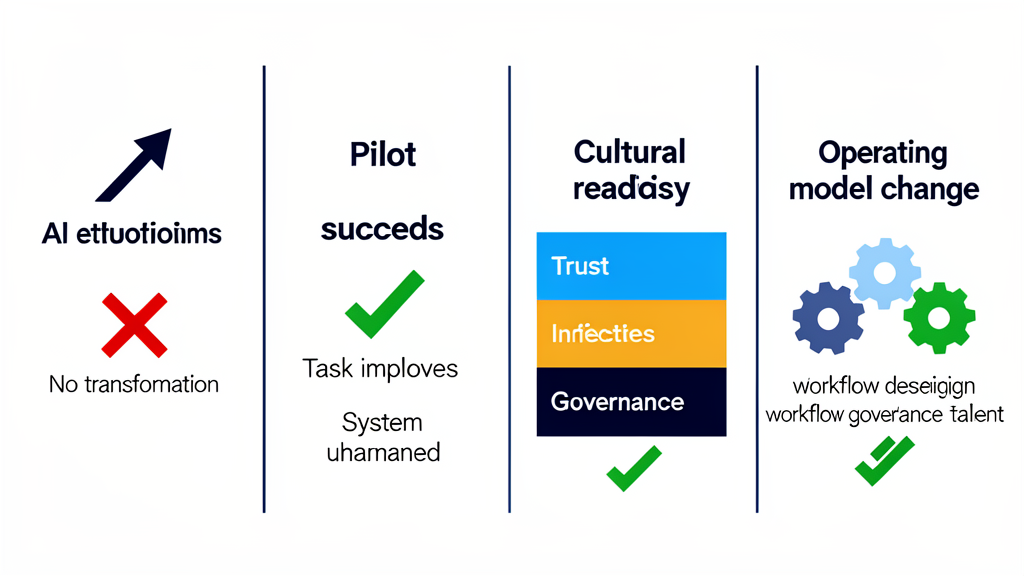
Many organisations are trapped in AI theatre. They have pilots, steering committees, innovation workshops, executive dashboards and enough vendor presentations to anesthetise a horse. The pilot succeeds. A team writes reports faster. A call-centre experiment improves response quality. Developers generate code more quickly. A department saves a few hours each week. Everyone agrees the technology works.
Then, somehow, almost nothing changes.
This happens because pilots optimise tasks, while transformation redesigns systems. A pilot can prove that a tool makes one activity faster. It does not prove that the organisation is willing to change approvals, roles, incentives, staffing models, quality controls, budgeting or decision rights around it.
The structural reasons are usually human rather than technical. Nobody measured the baseline, so nobody can prove the benefit. The old process remains in place, so the new one becomes optional. Middle managers sense that efficiency may reduce their headcount, budget or influence, so they become politely unenthusiastic. The organisation celebrates experimentation but does not decommission obsolete work. And so the AI pilot becomes another corporate souvenir: impressive in the meeting, irrelevant in the operating model.
The team brain and the jagged frontier
A large study of more than 5,000 customer-support agents found that access to a generative AI assistant improved productivity by roughly 14–15% overall, with much larger gains among less experienced workers. The remarkable part was not merely that people worked faster. It was that AI appeared to help newer workers adopt the language, patterns and practices of more experienced colleagues.
This matters because the most valuable knowledge in a business is rarely captured neatly in a document. It lives in judgement, experience, instinct, tone, sequencing, pattern recognition and the quiet expertise of people who have seen the movie before. I call this the team brain.
But AI can scale bad practice as easily as good practice. Harvard Business School research — the jagged frontier — found that AI improved performance on tasks inside its competence boundary, but could reduce performance when people used it on tasks outside that boundary. Worse, users did not always realise when they had crossed the line.
AI does not remove the need for judgement. It increases the value of judgement. The best organisations will not be the ones that blindly trust AI. They will be the ones that develop the cultural discipline to know when to use it, when to challenge it and when to leave it alone.
Shadow AI is a diagnostic, not just a risk
Microsoft's Work Trend research found that 78% of AI users were bringing their own AI tools to work. Much of this is useful. Some of it is risky. All of it is informative.
People do not usually reach for unofficial tools because they enjoy breaking policy. They do it because the official way of working is too slow, too clumsy or too painful. If a team is secretly using AI to rewrite client emails, summarise long reports or prepare meeting notes, leadership should not only ask "Is this safe?" They should ask "Why is the official workflow so bad that people had to invent a parallel one?"
The mature response is not prohibition. It is progression: approved tools, clear rules, practical training, sensible guardrails and enough trust that employees do not feel they have to hide useful work. This matters especially in Europe, where organisations must consider GDPR, the EU AI Act and broader expectations around accountability and transparency.
Trust is infrastructure
A great deal of discussion focuses on whether employees trust AI. That matters, but it is only half the story. The bigger issue may be whether employees trust the organisation using AI. People know that the same tools that help them work faster can also measure them more closely. If employees believe AI is a surveillance system wearing a productivity costume, they will not experiment freely. They will use it defensively, privately or not at all.
Without trust, adoption becomes theatre. With trust, it becomes learning. Leaders need to say clearly what AI-generated data will and will not be used for, explain how roles may change, and make experimentation socially safe.
Saved time is not value
A common mistake is assuming that saved time automatically becomes business value. It does not. Value equals time saved multiplied by the quality of reallocation. If AI saves five hours a week and those hours vanish into more meetings and more reports, the business has gained almost nothing. It has simply accelerated the treadmill.
The meaningful measures are not logins, prompts or licences. They are cycle-time reduction, margin improvement, revenue per employee, cost-to-serve, error reduction, customer retention and speed of decision-making. AI is only valuable when saved capacity is redirected toward constrained or high-value activities.
What high performers do differently
The highest-performing organisations are not simply more enthusiastic about AI. They are more serious about the surrounding system. They set bolder objectives, redesign workflows, involve senior leaders, clarify governance, train people in context, measure business outcomes and decide how saved capacity will be redeployed. They do not confuse activity with progress.
They also understand that AI maturity is a journey: tool adoption, individual productivity, workflow redesign, operating-model transformation, and finally business-model innovation. Most companies are still somewhere between stages one and two while talking as though they are at stage four.
The frozen middle
Senior leaders may sponsor AI. Frontline employees may experiment enthusiastically. But middle managers often sit between the two, uncertain whether AI threatens their authority, team size, status or relevance. They are rarely hostile in public. They simply slow things down. A delayed approval here, a cautious interpretation there, a "not yet" wrapped in responsible language — and suddenly transformation has become another committee.
This is not a reason to blame middle managers. It is a reason to include them properly. If they are expected to lead AI-enabled teams, they need training, incentives, authority and a clear view of their future role.
The organisations that learn fastest will win
The winners of the AI era may not be the companies with the largest budgets or the flashiest tools. They will be the companies that learn fastest — treating AI as an operating-model change rather than a software rollout, redesigning workflows instead of decorating old ones, surfacing shadow AI rather than pretending it does not exist, and building trust before demanding adoption.
Most importantly, they will understand that AI is a capability, not an outcome. Culture is the conversion mechanism. It decides whether that capability becomes better work, better decisions, better margins and better customer experiences — or just another round of AI theatre.
The technology is powerful. But culture decides whether it becomes a toy, a threat, a cost centre or a genuine source of competitive advantage.
Where to start
If you are planning or reviewing an AI transformation programme, start by assessing the cultural readiness alongside the technology stack. Map where shadow AI already exists, ask why the official workflow feels slower than the unofficial one, and make sure your middle managers have a clear stake in the change. Technology still matters. Culture decides whether it matters enough to transform.
Talk to Mission Institute